
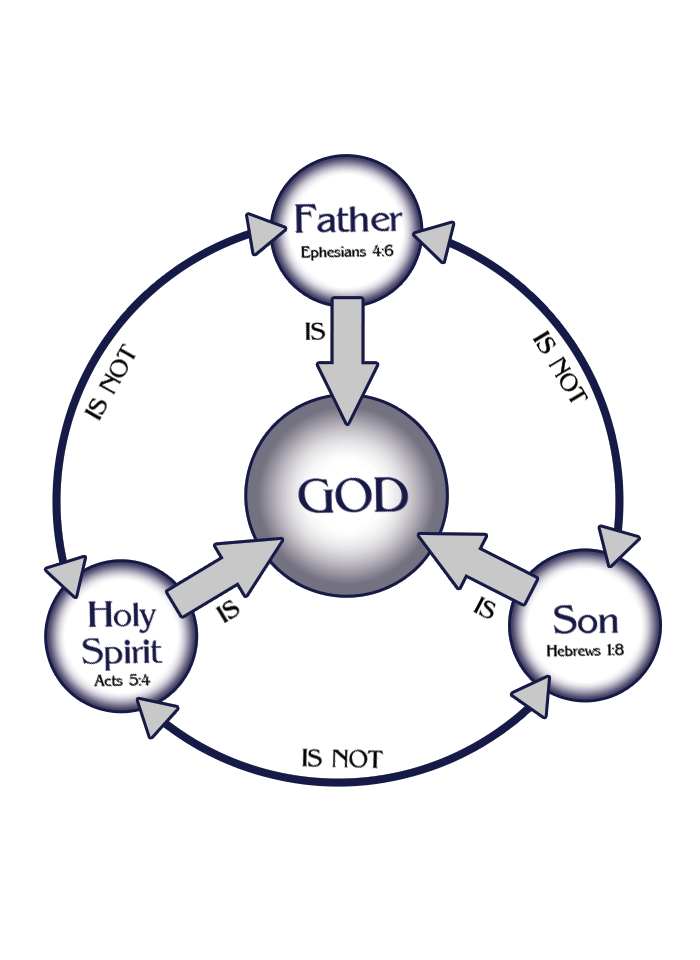
"Hear, O Israel: The LORD our God is one LORD." That is the starting line. Not a later invention. One God. The same Book that says one also speaks of the Father, of the Word who was with God and was God, and of the Spirit who is called God when He is lied to.
The word "trinity" is not in the text. The reality is. Three Persons, one essence, one will, one name. Anyone who makes three gods has left the Book. Anyone who flattens the three into one person wearing masks has left it too.
This is not a new doctrine. It is a way of holding what the words already say without forcing them into a formula that is smaller than they are.
God the Father is not a distant force. He is so powerful that His power is itself a Person: the Holy Spirit. "God is a Spirit." The Spirit of God moved upon the face of the waters before a single word of creation was spoken. That power is not a tool He picks up. It is Him, distinct enough that He can send the Spirit, and the Spirit can be lied to as God.
And His speech is the same. Not a sound that dies in the air. When God speaks, the Word stands as an entity of its own. "In the beginning was the Word, and the Word was with God, and the Word was God." With God: not the same Person. Was God: not a lesser being. The Word was made flesh. That is Jesus Christ. The Father's mere speech, so weighty that it manifests as a Person who can be seen, touched, crucified, and raised.
So the picture is not three separate gods deciding to cooperate. It is one God whose power is a Person and whose speech is a Person. The Father, the Spirit, the Word. One. Distinct. Never confused.
Some use one line to say the Son cannot be God. "But of that day and that hour knoweth no man, no, not the angels which are in heaven, neither the Son, but the Father." If the Son does not know, they say, He is not equal.
Hold the picture above next to that verse. The Word is what has been spoken. If the Father has not spoken a thing, how would the Word "know" it as a revealed fact? The final day and hour have not been spoken into the open. They sit with the Father until He speaks them. The Son, as the Word made flesh, can truly say that the hour has not been given to Him to declare. That is not a denial of deity. It is the nature of speech. What has not been said is not yet the Word that stands before men.
The same Jesus said, "I and my Father are one." He said, "He that hath seen me hath seen the Father." He accepted worship. He forgave sins. The hour not yet spoken does not cancel the rest of the record. It fits the record, once you stop treating the Word as a second god who is supposed to possess every unspoken thought of the Father as if He were a separate mind competing for information.
Deuteronomy 6:4. Isaiah 44:6. "Beside me there is no God." The foundation is not three. It is one.
Genesis 1:26. "Let us make man in our image." Not angels. The image is God's. Plural speech inside one Maker.
Isaiah 48:16. "The Lord GOD, and his Spirit, hath sent me." The speaker is the LORD, and the Spirit is named as the sender with Him.
Isaiah names the child born to us "The mighty God, The everlasting Father." John opens by saying the Word was God, then says the Word was made flesh. Thomas, standing in front of the risen Jesus, says "My Lord and my God" and is not corrected. Hebrews puts the Father's own words in the Son's direction: "Thy throne, O God, is for ever and ever."
Colossians is blunt: "For in him dwelleth all the fulness of the Godhead bodily." Not a portion. Not a reflection. The fulness, in a body.
Ananias lied about the price of a field. Peter said he had lied to the Holy Ghost. The next sentence: "thou hast not lied unto men, but unto God." The Spirit is not an influence. He is God, distinct enough to be lied to as a Person, identical enough that the lie is against God.
Jesus calls Him "another Comforter," a Person who can be sent, who teaches, who can be grieved. "God is a Spirit." The power of the Father is not impersonal electricity. It is the third Person.
Name. Singular. Three Persons under one name. That is the baptismal formula the church used from the start. It is not a later committee decision. It is the Lord's own mouth.
Paul closes a letter by naming all three in one blessing. He does not explain it. He assumes the churches already know who they are.
That is the plainest sentence in the whole Book on this subject. Father, Word, Holy Ghost. These three are one. It is not the only place the Godhead is shown. It is the place that says it in one line.
Most modern versions drop it. NIV, ESV, and the rest print a shorter line about the Spirit, the water, and the blood, and move the heavenly witnesses to a footnote or leave them out entirely. Catholic editions that follow the same critical Greek do the same. The defence is that the line is missing from most early Greek copies that have survived.
The defence does not erase the witnesses that kept it. Latin copies carried it for centuries. Early writers quoted the sense of three in heaven before the surviving Greek scraps were copied. The churches that received the text as Scripture kept the line. Removing it does not invent the doctrine of the Godhead. The rest of the Book already holds it. Removing it does make the doctrine easier to call a later invention, which is exactly how the shortened reading is used.
John 1:18 is handled the same way in some modern printings. God's words: "No man hath seen God at any time; the only begotten Son, which is in the bosom of the Father, he hath declared him." Some modern lines change "Son" to a phrase that softens the claim, or shift the weight so the begotten one is less clearly God. The pattern is familiar. Where a line makes the Godhead hard to dodge, a softer substitute appears.
Authenticity is not only a Greek argument. Any witness that speaks is evidence. The people closest to the apostles did not treat the Father, the Son, and the Spirit as three gods or as one person with three titles.
Ignatius, writing within living memory of the apostles, greets churches in the name of the Father and of Jesus Christ, and speaks of the Spirit as the one who establishes them. He calls Jesus God without apology. Irenaeus, a generation later, says the church everywhere had received the faith in one God the Father, in one Jesus Christ the Son of God, and in the Holy Spirit. Tertullian, early in the third century, is the first to use the word "trinity" in Latin, and he uses it for exactly this: one substance, three Persons, Father, Son, and Spirit. He is not inventing. He is naming what the churches already confessed at baptism.
The baptismal practice itself is a witness. From the earliest records, people were baptized into the name of the Father, and of the Son, and of the Holy Ghost. Not into three names. Into one name that holds three. That practice did not wait for a council. The council that later used the word "trinity" was answering people who denied what the churches had already been saying with water.
Old Testament patterns sit underneath all of it. The Spirit of God moves before the first creative word. God speaks, and the Word does the work. "Let us" is not a royal we. The image is singular. The speakers are plural. Isaiah hears the LORD and His Spirit sending the speaker. None of this is a Greek philosophical import. It is the way the Book has always talked.
Deuteronomy 6:4 still stands. One LORD. The Persons are not a committee.
The Father sends the Son. The Son prays to the Father. The Spirit is sent by both. Masks do not send each other.
The Word was in the beginning. All things were made by Him. A creature cannot be the Maker of all things.
The Spirit teaches, can be grieved, can be lied to, and the lie is against God. A force does not do that.
The gospel is not a formula about three. It is believing who Jesus Christ is. He is the Word made flesh. He is the Son. He is God with us. He died for our sins according to the scriptures, was buried, and rose again the third day according to the scriptures. The Father sent Him. The Spirit bears witness of Him. One God. One Saviour. One name.