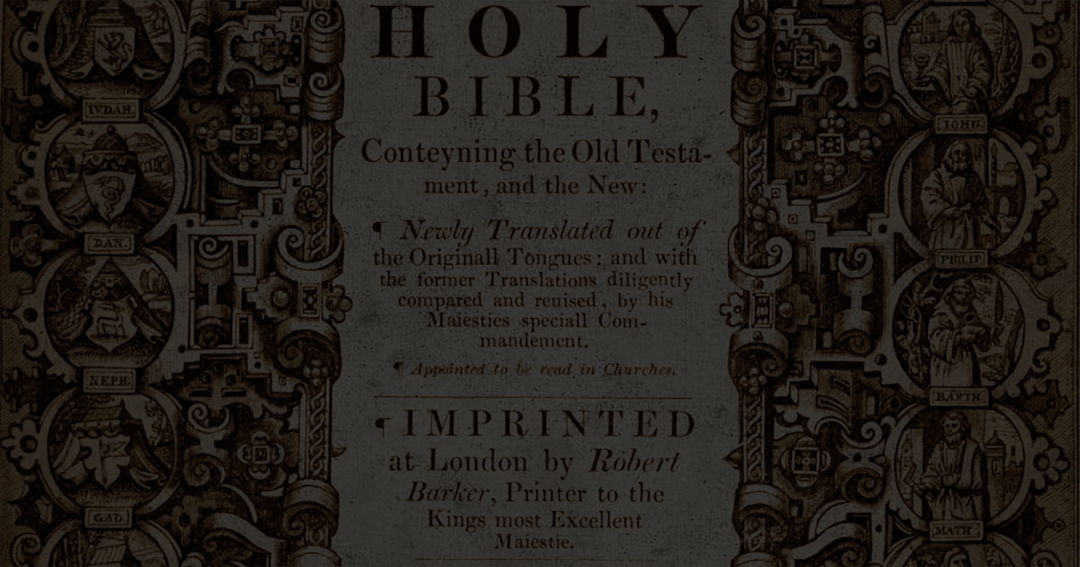

The King James Bible did not appear from nowhere. Its Old Testament rests on the Hebrew Masoretic Text. Its New Testament rests on the Greek text that had been the dominant form in the churches of the East for more than a thousand years — the stream later printed as the Textus Receptus. Into English that stream ran through Tyndale and the successive revisions that purified the language until 1611.
God promised to preserve His words. The history below shows how that promise was kept, often at the cost of blood.
Long before printing presses, the words of God were carried by people who treated them as life. The dedication required to keep a text pure across centuries is easy to underestimate.
Israel was commanded to teach the words diligently to their children, to speak of them in the house and by the way, lying down and rising up. Formal instruction of children in the Scriptures was established early. By the time of the Second Temple, teachers of young children were appointed in cities and provinces.
A Torah scroll is written without vowels or punctuation. The exact reading — every letter, every pause, every traditional division — was therefore carried in the mind and the mouth. The oral tradition was not a casual memory exercise. It was the living standard against which every new copy was checked.
From roughly the sixth to the tenth centuries the Masoretes fixed that already ancient tradition in writing with extraordinary care: letter counts, word counts, marginal notes recording every anomaly, rules that made a single wrong letter grounds for rejecting a scroll. They did not invent the Hebrew text. They inherited a consonantal text that had already been in use for centuries and locked it down so it could not drift.
The New Testament writings were copied and circulated while the apostles were still alive. Churches multiplied the letters and Gospels. When persecution came, manuscripts were hunted and burned. Believers hid them, recopied them, and died rather than surrender them.
In the Greek-speaking East a stable form of the text became dominant from the fourth and fifth centuries onward — the Byzantine text-type. It is witnessed by the large majority of surviving Greek manuscripts, roughly five thousand. That is the stream that later editors would print as the Textus Receptus.
Early papyri and the great uncials remain important witnesses. The mass of later Byzantine copies, however, is not a late invention; it is the continued use of the text that had already become standard in the churches of the East.
“The words of the LORD are pure words: as silver tried in a furnace of earth, purified seven times. Thou shalt keep them, O LORD, thou shalt preserve them from this generation for ever.”
Psalm 12:6-7A common objection is that the Masoretic Text is late — that the Masoretes of the sixth to tenth centuries invented or heavily reshaped the Hebrew Bible. The manuscript record says otherwise. The Masoretes inherited a consonantal text that was already ancient, already stable, and already the standard in the mainstream of Judaism.
Two silver amulets from a Jerusalem burial cave carry the Priestly Blessing of Numbers 6:24–26. These are the oldest known biblical Hebrew fragments. They predate the Dead Sea Scrolls by about five centuries and match the traditional wording. The text was already fixed in the First Temple period.
Scrolls from Masada, Murabba‘at, Naḥal Ḥever and related sites (late 1st century BC to early 2nd century AD) show nearly complete identity with the later medieval Masoretic Text — commonly around 98% agreement in the consonants. These are true proto-Masoretic manuscripts, a thousand years older than the Masoretes themselves.
Qumran displays more variety, yet a clear MT-like group exists. The second Isaiah scroll from Cave 1 (1QIsab) stands close to the Masoretic text of Isaiah. Even the famous Great Isaiah Scroll (1QIsaa, c. 125 BC) is substantially the same book; the large majority of differences are spelling and minor orthography.
The line is therefore continuous: pre-exilic fragments, proto-Masoretic scrolls in the Judean Desert, continuous use in the synagogues and rabbinic circles, then Masoretic stabilisation with vowel points and the Masorah. The Bomberg / Ben Chayyim Rabbinic Bible of 1524–25, used by the King James translators, stands at the end of that chain — not at the start of a new one.
The Law, the Prophets and the Writings were written, copied by scribes, and taught to successive generations. The precision of the later Masoretic tradition rests on this earlier, continuous care.
Two silver amulets from a burial site near Jerusalem contain the Priestly Blessing of Numbers 6:24–26. These are the oldest known fragments of biblical Hebrew text — roughly five centuries older than the Dead Sea Scrolls — and they match the traditional wording. The text was already fixed and circulating in the First Temple period.
Scrolls from Masada, Murabba‘at, Naḥal Ḥever and related sites show almost complete identity with the later medieval Masoretic Text (commonly cited around 98% agreement in the consonants). These proto-Masoretic manuscripts prove the text the Masoretes later pointed was already the standard in mainstream Jewish circles a thousand years earlier. At Qumran, “MT-like” scrolls (including 1QIsab) stand close to the same tradition.
Families of Jewish scholars (especially in Tiberias and Babylon) inherited that ancient consonantal text, added vowel points and accents, and recorded exhaustive marginal notes so that every letter could be checked. A single wrong letter could invalidate a Torah scroll. The Ben Chayyim / Bomberg Rabbinic Bible of 1524–25, used by the King James translators for the Old Testament, stands in this line.
The Gospels, Acts, Epistles and Revelation were written and immediately copied for the churches.
Greek manuscripts multiplied. Translations into Latin (the Old Latin / Vetus Latina) and Syriac (including the Peshitta tradition) carried the text into new languages. These early versions remain important witnesses to the wording then in circulation.
The form of the Greek text used in the churches of the Byzantine world became the majority text. It is represented by the great mass of surviving Greek manuscripts. This is the stream later printed as the Textus Receptus. (The name “Textus Receptus” itself belongs to the printed editions of the 16th century; the underlying text-type is far older.)
Groups such as the Waldensians (from the late 12th century) and later the Lollards treasured Scripture in the common tongue and suffered for it. Their history is one of persecution, not of inventing a second-century “Waldensian Bible.” The dedication is real; the exaggerated early dates sometimes attached to them are not.
The New Testament is the best-attested work of antiquity. The early papyri, the great uncial codices, and the thousands of later minuscules together form a dense web of evidence. The Byzantine / majority stream that underlies the Textus Receptus is not isolated from that early evidence; it is the form that continued in ordinary church use.
Fragments such as P52 (a small piece of John’s Gospel, often dated to the early or mid-second century) show the text already circulating far from its place of origin within a lifetime of the apostles. Other early papyri (P46 for the Pauline letters, P66 and P75 for the Gospels, and many more) push substantial portions of the New Testament back into the second and third centuries. These are not the whole story, but they prove the writings were being copied carefully and widely very early.
From the fourth century onward we have complete or nearly complete codices on parchment. Codex Sinaiticus and Codex Vaticanus are the most famous of the Alexandrian stream. Codex Alexandrinus and Codex Ephraemi are also major witnesses. Codex Bezae represents a “Western” form. These manuscripts are invaluable — and they are also a minority when the full body of Greek evidence is counted.
The large majority of surviving Greek manuscripts — roughly five thousand — belong to the Byzantine text-type. This is the form that dominated the Greek-speaking churches for over a thousand years. When Erasmus, Stephanus and Beza printed the Greek New Testament in the sixteenth century, they worked from manuscripts of this tradition. The resulting printed text became known as the Textus Receptus, the “received text.”
Early translations into Syriac, Latin (the Old Latin), Coptic and other languages, together with thousands of quotations in the church fathers, provide independent checks on the Greek. Where the early versions and the fathers align with the Byzantine wording, they confirm that those readings were not late inventions but part of the living text of the churches.
The King James New Testament rests on this received Greek stream, filtered through Tyndale and the English line that followed. The mass of evidence does not point to a text that was lost and then reconstructed in the nineteenth century. It points to a text that was never out of the hands of the churches that used it.
The Received Text entered English through men who paid for it. Tyndale’s work is the foundation. Each major English Bible after him revised and purified the language until the seventh stood complete.
William Tyndale translated from the Greek. His 1534 revision refined the work. He was betrayed, strangled and burned in 1536. His dying prayer — “Lord, open the King of England’s eyes” — was answered in the generations that followed. A very large proportion of the King James New Testament still carries Tyndale’s wording.
Miles Coverdale produced the first complete printed English Bible, drawing heavily on Tyndale for the New Testament and the portions of the Old Testament Tyndale had finished, and completing the rest from other sources.
John Rogers, using the name Thomas Matthew, combined Tyndale’s published and unpublished work with Coverdale’s. It was the first complete English Bible issued with royal licence.
A revision of Matthew’s Bible under Coverdale’s hand, ordered for every parish church. Large in size, chained to lecterns, it put the English Scriptures before the common people by royal authority.
Produced by English exiles in Geneva. The first English Bible translated by a scholarly committee, the first to use verse divisions throughout, and for decades the household Bible of England. Its influence on the King James is deep.
An official revision under Archbishop Matthew Parker, intended as the pulpit Bible of the Church of England. It became the formal base text the King James companies were instructed to follow where possible.
Six companies of translators, working from the Hebrew and Greek, with the Bishops’ Bible as the English starting point and constant reference to Tyndale, Coverdale, Matthew, the Great Bible and Geneva. The result is the Book that carried the gospel in English across the world.
The standard Oxford edition that regularised spelling and typography. It is a language update, not a new translation. The text in common use today is this line of the 1611 work.
The King James translators worked from the Hebrew Masoretic Text, principally the second Rabbinic Bible printed by Daniel Bomberg (1524–25), edited by Jacob ben Chayyim. That edition stands in the Masoretic tradition described above.
Erasmus published the first printed Greek New Testament in 1516, with important later editions (especially 1522). Robert Estienne (Stephanus) issued influential editions, notably 1550. Theodore Beza’s editions (including 1598) were also used. These printed texts drew on the Byzantine / majority manuscript tradition and became known as the Textus Receptus — the “received text.”
Preservation was never automatic. It was paid for.
Tyndale was hunted across Europe, finally betrayed, and executed. John Rogers, the man behind Matthew’s Bible, was the first Protestant martyr under Mary I. Countless unnamed believers hid manuscripts, recopied them by hand, and refused to surrender them when the alternative was death. Foxe’s record of the English martyrs is only one window into a much longer story of men and women who treated the words of God as worth more than their own lives.
That is the real lineage: not a chain of perfect institutions, but a chain of people who believed God had spoken and who would not let the words be erased.
From the Hebrew scribes and the Greek churches of the East, through Tyndale’s blood and the companies of 1611, the Book that reached the English-speaking world is the same gospel: Christ died for our sins, was buried, and rose again the third day according to the scriptures. The lineage is not a museum piece. It is the reason ordinary people can still hold the words of God in their hands.
See also The Book of the LORD and Inerrancy.