
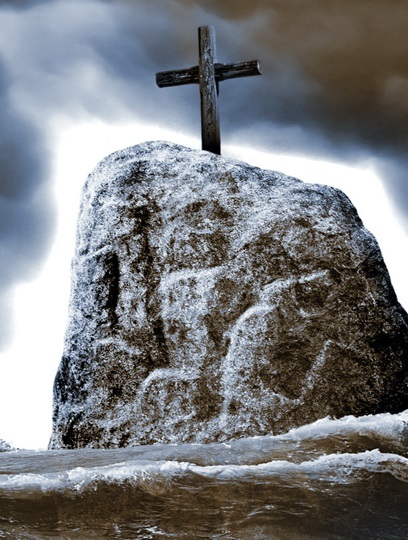
The root problem with making Peter the rock is ignorance of the revelation given in Matthew 16. Jesus asks Peter:
“But whom say ye that I am?”
The answer is revealed to Peter by the Father. That answer is the basis of the gospel:
“Thou art the Christ, the Son of the living God.”
This revelation is supported throughout scripture as the answer for salvation. We are saved by believing in who Jesus Christ is and what He did. Peter did nothing for our salvation. It was all Christ.
If you want Peter as the rock, you have to rewrite most of the Bible.
“He saith unto them, But whom say ye that I am? And Simon Peter answered and said, Thou art the Christ, the Son of the living God. And Jesus answered and said unto him, Blessed art thou, Simon Bar-jona: for flesh and blood hath not revealed it unto thee, but my Father which is in heaven. And I say also unto thee, That thou art Peter, and upon this rock I will build my church; and the gates of hell shall not prevail against it.”
Matthew 16:15-18The Catholic system reads “this rock” as Peter the man, and from that reading builds the entire papal claim: Peter as the first pope, Rome as the seat of authority, and succession through a line of bishops of Rome. The text does not say that. The blessing falls on the revelation the Father gave. The rock on which the church is built is the truth just confessed — that Jesus is the Christ, the Son of the living God.
In the Greek, Peter is petros (a stone, masculine). The rock is petra (a mass of rock, feminine). The shift in word and gender is not accidental. Jesus is distinguishing the man from the foundation. The foundation is the confession and the Person confessed.
Matthew was written in Greek. The words that stand in the text are the ones God has preserved for us to read. Petros is a masculine noun commonly used for a stone or a piece of rock — something a man can pick up or throw. Petra is a feminine noun used for a mass of rock, a cliff, a bedrock foundation. Jesus does not say “you are Petros, and upon this Petros I will build.” He says “you are Petros, and upon this petra I will build.” The change of word and of gender is deliberate. If the Lord had intended to identify Peter himself as the foundation, the natural Greek would have kept the same word.
The confession just spoken — “Thou art the Christ, the Son of the living God” — is the natural referent of “this rock.” The Father revealed it; Jesus builds upon it. Peter is blessed for receiving that revelation. He is not turned into the foundation of the church.
The common reply is that Jesus was speaking Aramaic, and in Aramaic the word would have been kepha (or Cephas) for both, so the Greek distinction is only a translator’s artifact. That claim does not settle the matter.
First, we do not possess an Aramaic original of Matthew. What we have is the Greek text. Arguments that rewrite the Greek on the basis of a reconstructed Aramaic are arguments from silence. The Holy Spirit gave us the Greek wording; that is the text we are bound to.
Second, even if Jesus spoke Aramaic on that occasion, Matthew (or the Spirit through Matthew) chose two different Greek words when recording it. That choice is itself interpretation under inspiration. If the intent had been identity of person and foundation, Greek had the means to say so. It did not.
Third, John 1:42 records that Jesus gave Simon the name Cephas, “which is by interpretation, A stone.” The interpretation supplied by scripture is “a stone” — consistent with petros, not with the massive foundation-rock sense of petra. Peter himself later calls believers “lively stones” and Christ the “chief corner stone” (1 Peter 2:4-6). He never claims the foundation role for himself.
Fourth, the rest of the New Testament never treats Peter as the unique rock of the church. It repeatedly names Christ as the rock, the living stone, and the only foundation. An Aramaic theory that forces Matthew 16 to mean the opposite of everything else is special pleading.
The Catechism of the Catholic Church leans hard on a singular reading: Peter alone receives a unique authority that becomes the basis of the papacy. The same Catechism, however, cannot escape the wider New Testament data.
It affirms that the power to bind and loose was also given to the college of the apostles (cf. Matthew 18:18). The keys language and the binding/loosing language are not locked exclusively to one man in the text of the Gospels. Matthew 18 addresses the disciples in the plural. The authority to discipline, to declare, and to act in the name of Christ is given to the gathered body, not reserved to a single successor of Peter.
That creates a plain tension. If Matthew 16 is used to establish a unique, transferable, singular office in Peter, then Matthew 18 (and the shared apostolic foundation in Ephesians 2:20) undercuts the exclusivity. If the keys and the binding power belong to the apostles as a whole, then the leap from “Peter confessed the Christ” to “Peter and his Roman successors are the rock and the head of the church” is no longer supported by the passage. The Catechism tries to hold both: a singular Petrine supremacy and a collegial sharing of the same powers. Scripture does not require the supremacy; it does show the shared commission.
In short: the Greek text distinguishes the man from the foundation; the Aramaic reconstruction is an argument from a text we do not have; and the Catholic system itself admits that the binding and loosing were not given to Peter alone. The rock remains what the Father revealed and what Peter confessed — Jesus the Christ, the Son of the living God.
Only a few verses later, the same Peter who has just been blessed is rebuked in the strongest terms:
“But he turned, and said unto Peter, Get thee behind me, Satan: thou art an offence unto me: for thou savourest not the things that be of God, but those that be of men.”
Matthew 16:23If Peter the man were the unshakeable rock of the church, this rebuke would be unthinkable. The rock does not need to be told to get behind the Lord as Satan. The man does. The foundation is not the fluctuating disciple; it is the Christ he had just confessed.
Later Peter would deny the Lord three times. He was restored by grace, not elevated into an office of infallible headship. Scripture records both his courage and his failure without ever placing the church upon him as its foundation.
If Peter understood himself to be the rock of the church, his own letters would show it. They do the opposite. He points away from himself and toward Christ.
“To whom coming, as unto a living stone, disallowed indeed of men, but chosen of God, and precious, Ye also, as lively stones, are built up a spiritual house, an holy priesthood, to offer up spiritual sacrifices, acceptable to God by Jesus Christ. Wherefore also it is contained in the scripture, Behold, I lay in Sion a chief corner stone, elect, precious: and he that believeth on him shall not be confounded. Unto you therefore which believe he is precious: but unto them which be disobedient, the stone which the builders disallowed, the same is made the head of the corner, And a stone of stumbling, and a rock of offence, even to them which stumble at the word, being disobedient: whereunto also they were appointed.”
1 Peter 2:4-8Christ is the living stone. Christ is the chief cornerstone. Believers are lively stones built upon Him. The stone the builders rejected is made the head of the corner. Peter applies the Old Testament cornerstone passages to Jesus, not to himself. He places every believer as a stone in the house — not under a papal head, but upon Christ.
“This is the stone which was set at nought of you builders, which is become the head of the corner. Neither is there salvation in any other: for there is none other name under heaven given among men, whereby we must be saved.”
Acts 4:11-12Preaching in Jerusalem, Peter again identifies the rejected stone with Jesus. Salvation is in no other name. The man who is supposed to be the foundation of a hierarchical system is, in his own mouth, pointing every hearer to Christ alone.
“For other foundation can no man lay than that is laid, which is Jesus Christ.”
1 Corinthians 3:11Paul leaves no room for a second foundation. The foundation is already laid. It is Jesus Christ.
“And did all drink the same spiritual drink: for they drank of that spiritual Rock that followed them: and that Rock was Christ.”
1 Corinthians 10:4The Rock in the wilderness was Christ. The same identification runs through the New Testament.
“And are built upon the foundation of the apostles and prophets, Jesus Christ himself being the chief corner stone.”
Ephesians 2:20The apostles and prophets form part of the foundation structure; the chief cornerstone is Jesus Christ Himself. Peter is one among the apostles, not the unique rock beneath them all.
“Therefore thus saith the Lord GOD, Behold, I lay in Zion for a foundation a stone, a tried stone, a precious corner stone, a sure foundation: he that believeth shall not make haste.”
Isaiah 28:16The sure foundation promised by God is the stone laid in Zion. The New Testament applies this to Christ, not to Peter.
The keys of the kingdom and the power of binding and loosing are often treated as if they belonged to Peter alone and then passed to a line of Roman bishops. Scripture does not restrict them that way.
“Verily I say unto you, Whatsoever ye shall bind on earth shall be bound in heaven: and whatsoever ye shall loose on earth shall be loosed in heaven. Again I say unto you, That if two of you shall agree on earth as touching any thing that they shall ask, it shall be done for them of my Father which is in heaven. For where two or three are gathered together in my name, there am I in the midst of them.”
Matthew 18:18-20The same authority language is given to the disciples in the plural. The presence of Christ is promised where two or three are gathered in His name — not where a single successor of Peter sits in a designated city. The gates of hell shall not prevail against the church built on the confession of Christ. That is a promise about the gospel and the people who believe it, not a guarantee of an unbroken political succession in Rome.
If Peter were the visible head of the church with universal jurisdiction, the book of Acts and the epistles would show it. They do not.
In Acts 15 the question of Gentile circumcision is settled in Jerusalem. Peter speaks, but it is James who summarises the decision and whose judgment carries the assembly. There is no papal decree from Peter. There is deliberation among the apostles and elders, and the word of God governing the outcome.
“But when Peter was come to Antioch, I withstood him to the face, because he was to be blamed.” (Galatians 2:11). An apostle publicly corrects Peter for conduct that was not according to the truth of the gospel. That is not how one treats an infallible head of the church. It is how one treats a fellow apostle who needs to be brought back into line with the gospel.
Nowhere does scripture appoint Peter as the first of a line of Roman bishops, or transfer unique authority from him to a successor in Rome. The office of apostle is tied to eyewitnesses of the resurrection and to the foundation period of the church. It is not a perpetual monarchy seated in one city.
The New Testament repeatedly names Christ as the head of the church (Ephesians 1:22-23; 5:23; Colossians 1:18). A system that inserts a visible human head between Christ and His body is adding what scripture never requires and often contradicts.
To make Peter the rock of the church in the Catholic sense, one must:
That is not exposition. It is a system imposed on the text. The scriptures, read in their own flow, present Christ as the rock, the living stone, the chief cornerstone, and the only foundation. Peter is a faithful apostle who confessed that truth, fell, was restored, and spent the rest of his ministry pointing others to the same Lord.
The church is built on the revelation the Father gave: Jesus is the Christ, the Son of the living God. That is the rock. The gates of hell shall not prevail against it. Peter knew it. Paul knew it. The whole of scripture knows it. Hold that confession, and you stand on the only foundation that cannot be moved.
See also Salvation, The Eucharist and Textual Corruption.