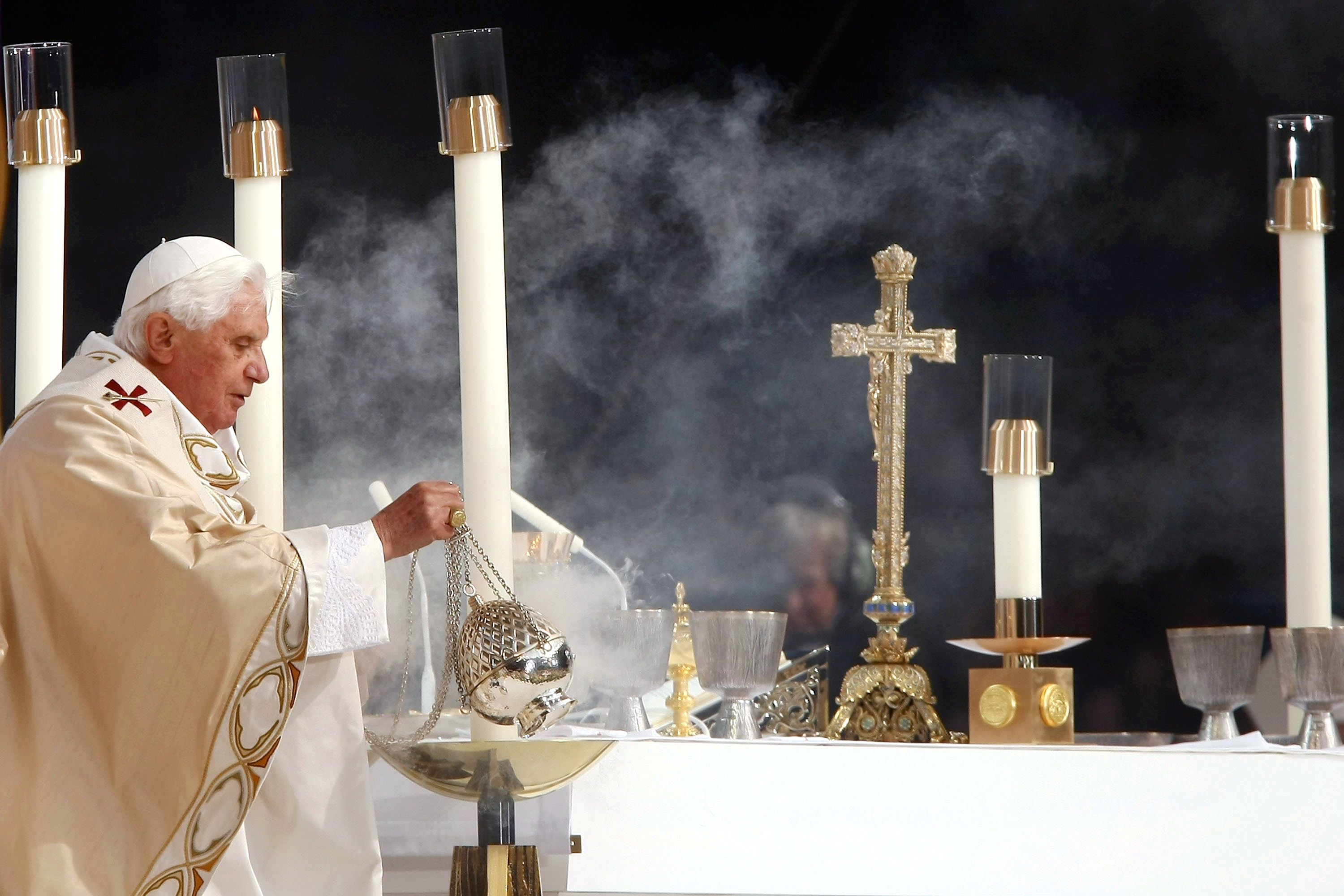
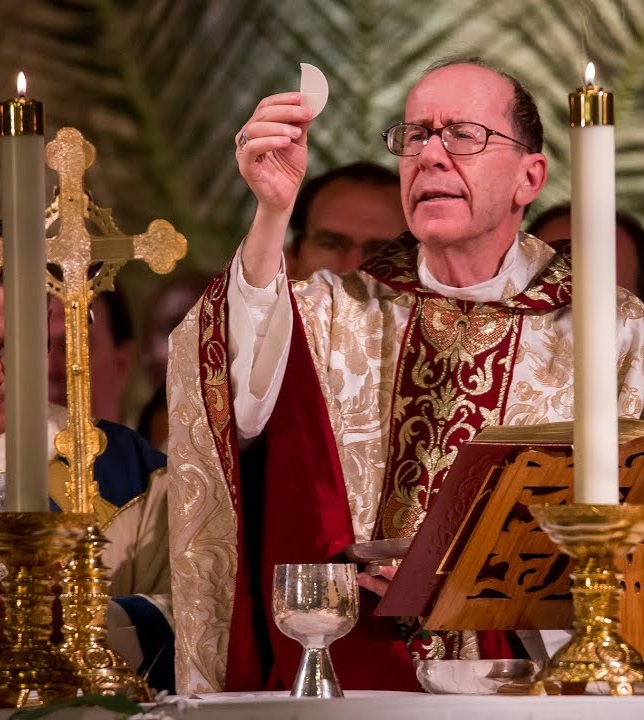
The Catechism states that the Mass is “the source and summit of the Christian life” — that is, the origin of the Christian life and its high point.
Cardinal Ratzinger, calling himself Pope Benedict, said: “The Mass is the sum and substance of our faith.”
If that is true, then what the Mass teaches about sacrifice, presence, and redemption must be weighed against God’s words. Where it contradicts them, it cannot stand.
If anyone denies that in the sacrament of the most holy Eucharist are contained truly, really, and substantially the body and blood together with the soul and divinity of our Lord Jesus Christ, and consequently the whole Christ, but says that He is in it only as a sign or figure or force, let him be anathema.
Damnation is pronounced on anyone who says that Christ is not actually present — body, blood, soul, and divinity — in the wine and the wafer. Anathema here means a solemn curse and excommunication: in the system’s own logic, whoever rejects these doctrines is cut off, for “there is no salvation outside the Catholic Church.”
That is not a minor liturgical preference. It is a claim that the gospel itself is bound to a repeated, physical presence of Christ in the elements, under pain of eternal loss. Scripture never places salvation there.
“The sacrifice of Christ and the sacrifice of the Eucharist are one single sacrifice: ‘The victim is one and the same: the same now offers through the ministry of priests, who then offered himself on the cross; only the manner of offering is different.’ In this divine sacrifice which is celebrated in the Mass, the same Christ who offered himself once in a bloody manner on the altar of the cross is contained and offered in an unbloody manner.”
If it is the sacrifice of Jesus, it cannot be done in an “unbloody manner.” God’s word is plain:
“And almost all things are by the law purged with blood; and without shedding of blood is no remission.”
Hebrews 9:22What happened at Calvary was a one-time historical event and accomplished its purpose:
“For by one offering he hath perfected for ever them that are sanctified.”
Hebrews 10:14“When the Church celebrates the Eucharist, she commemorates Christ’s Passover, and it is made present. As often as the sacrifice of the Cross… is celebrated on the altar, the work of our redemption is carried out.” And again: “Every time this mystery is celebrated, ‘the work of our redemption is carried on’…”
Scripture says the opposite on every point that matters.
“…by his own blood he entered in once into the holy place, having obtained eternal redemption for us.”
Hebrews 9:12“By the which will we are sanctified through the offering of the body of Jesus Christ once for all.”
Hebrews 10:10“Who needeth not daily, as those high priests, to offer up sacrifice… for this he did once, when he offered up himself.”
Hebrews 7:27“But this man, after he had offered one sacrifice for sins for ever, sat down on the right hand of God.”
Hebrews 10:12“So Christ was once offered to bear the sins of many…”
Hebrews 9:28“For Christ also hath once suffered for sins, the just for the unjust, that he might bring us to God, being put to death in the flesh, but quickened by the Spirit.”
1 Peter 3:18“When Jesus therefore had received the vinegar, he said, It is finished.”
John 19:30Christ is not present to be sacrificed again. He is risen and alive and sits at the right hand of the Father:
“Knowing that Christ being raised from the dead dieth no more; death hath no more dominion over him. For in that he died, he died unto sin once: but in that he liveth, he liveth unto God.”
Romans 6:9-10The work of our redemption is not ongoing. One does not keep working on what has already been finished at the cross.
“…we express our faith in the real presence of Christ under the species of bread and wine by, among other ways, genuflecting or bowing deeply as a sign of adoration of the Lord.”
That is the worship of an object under the claim that the object has become God. God’s word forbids the worship of any image or likeness, even when intended to represent Him:
“Thou shalt not make unto thee any graven image, or any likeness of any thing that is in heaven above, or that is in the earth beneath, or that is in the water under the earth: Thou shalt not bow down thyself to them, nor serve them…”
Exodus 20:4-5“I am the LORD: that is my name: and my glory will I not give to another, neither my praise to graven images.”
Isaiah 42:8“Forasmuch then as we are the offspring of God, we ought not to think that the Godhead is like unto gold, or silver, or stone, graven by art and man’s device.”
Acts 17:29“The Eucharistic sacrifice is also offered for the faithful departed who have died in Christ but are not yet wholly purified, so that they may be able to enter into the light and peace of Christ.”
It is too late for the dead. After death comes judgment, not a second chance through a ritual performed by the living:
“And as it is appointed unto men once to die, but after this the judgment.”
Hebrews 9:27Salvation is received in this life by believing on the Lord Jesus Christ — not by masses offered after one has already died.
The tabernacle is to be situated “in churches in a most worthy place with the greatest honor… The dignity, placing, and security of the Eucharistic tabernacle should foster adoration before the Lord really present in the Blessed Sacrament of the altar.”
The claim is that Christ is really present in the reserved elements and is to be adored there. Scripture says the Most High does not dwell in temples made with hands:
“Howbeit the most High dwelleth not in temples made with hands; as saith the prophet, Heaven is my throne, and earth is my footstool: what house will ye build me? saith the Lord: or what is the place of my rest?”
Acts 7:48-49Christ is risen. His flesh saw no corruption. He lives forevermore at the right hand of God — not distributed into boxes in buildings across the world.
“He seeing this before spake of the resurrection of Christ, that his soul was not left in hell, neither his flesh did see corruption.”
Acts 2:31“I am he that liveth, and was dead; and, behold, I am alive for evermore.”
Revelation 1:18Being saved involves no works of the law, no repeated sacrifices, no rosaries, no confessions to a priest to secure eternal life. The gift is received by faith:
“For by grace are ye saved through faith; and that not of yourselves: it is the gift of God: Not of works, lest any man should boast.”
Ephesians 2:8-9“Therefore being justified by faith, we have peace with God through our Lord Jesus Christ.”
Romans 5:1“In whom we have redemption through his blood, even the forgiveness of sins.”
Colossians 1:14There is a difference between universal provision (Christ the Saviour of the world) and individual application (as many as received Him). Jesus paid the price. You must receive it by believing on Him — not by attending a ritual that claims to re-present His death.
The practices of the Mass set aside the plain teaching of the apostles and of Jesus Christ Himself. They turn a finished, once-for-all sacrifice into a repeated unbloody offering; they place Christ in bread and wine to be adored; they offer that ritual for the dead; and they bind salvation to a system that scripture never authorised.
Christ died once. He rose. He sat down. It is finished. Believe on the Lord Jesus Christ, and thou shalt be saved.
See also The Eucharist, Salvation and Peter the rock.